If you have five to seven safari days, Kenya is usually the easier first choice. If you have eight to ten days or more and want a bigger sense of wilderness, Tanzania becomes much harder to argue against.
That is the short answer. The longer answer depends on the month you travel, whether the Great Migration matters, how much road time you tolerate and whether your safari needs to finish on a beach.
The animals do not respect the border. Your itinerary does.

Kenya is easier to make work in a shorter trip
Kenya's classic safari circuit radiates efficiently from Nairobi. The Masai Mara National Reserve, Amboseli National Park, Lake Nakuru, Lake Naivasha and conservancy areas can be combined in several sensible ways without needing a very long holiday.
That matters on a first safari because every transfer competes with wildlife time.
With seven days, Kenya can give you two or three distinct areas and still allow several full game-drive days. With the same amount of time in Tanzania, you can absolutely have a superb safari, but the scale of the northern circuit means route decisions become more important.
This is why we generally point time-poor first-timers toward Kenya rather than claiming Kenya has “better” wildlife. It is a logistics advantage, not a biological one.
Tanzania gives you more scale
The Serengeti National Park is vastly larger than the Masai Mara, and that scale changes the safari experience.
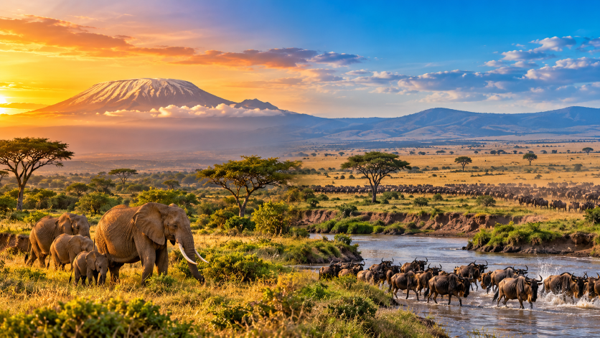
You can drive for long stretches through open country where the landscape itself becomes part of the trip. Different sections of the Serengeti matter at different times of year, particularly because the Great Migration spends much of its annual cycle on the Tanzanian side of the ecosystem.
Then there is the Ngorongoro Conservation Area. The crater creates a completely different setting from the Serengeti and is one of the strongest reasons to choose Tanzania for a first safari.
Add Tarangire National Park, known for elephants, baobabs and dry-season concentrations around the river, and the northern circuit has enough variety to fill a week without feeling repetitive.
Tanzania is not simply “the Serengeti, but bigger”. It is a series of ecosystems that reward time.
Wildlife: there is no clean winner
Both countries offer excellent Big Five viewing when the right parks are combined. Both support lions, leopards, cheetahs, elephants, buffalo, giraffes, zebra, wildebeest and a long list of antelope and bird species.
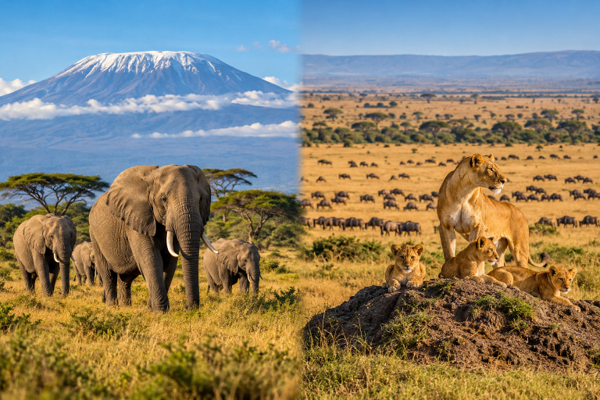
Kenya's advantage is density and variety within a shorter circuit. The Mara is particularly strong for predators, Amboseli for elephants, and places such as Nakuru and private conservancies can add rhino and different styles of game viewing.
Tanzania's advantage is scale and the ability to follow major wildlife concentrations through a wider landscape. The Serengeti and Ngorongoro combination can produce an extraordinary range of sightings without crossing a national border.
If somebody tells you one country has “the wildlife” and the other does not, the comparison is being oversimplified.
The Great Migration is one event, not two
The Great Migration moves through the Serengeti-Mara ecosystem according to rainfall and grazing conditions.
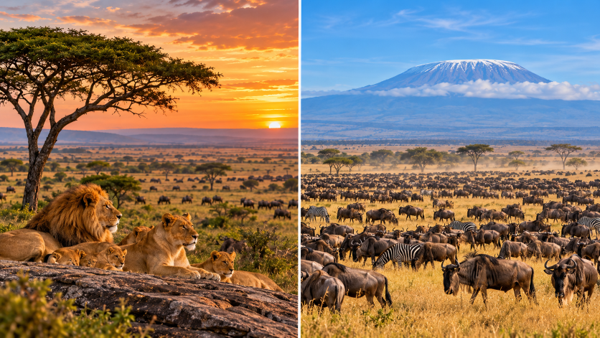
Kenya's famous chapter is the period when large herds move into the greater Mara ecosystem, generally around July to October. This is the period associated with dramatic Mara River crossings on the Kenyan side.
Tanzania hosts other major phases of the cycle, including the southern Serengeti calving period early in the year and the movement north through different Serengeti regions.
So the migration question should start with when are you travelling?
If you are travelling in February because you want calving and predator activity, Tanzania makes more sense. If you are travelling in August and your priority is the Kenyan side of the Mara River crossing season, Kenya does.
Do not choose the country first and then force the migration calendar to agree with you.

Kenya has a stronger short-trip rhythm
A first safari needs variety, but it also needs rest.
Kenya makes it easy to build a rhythm such as:
Amboseli → Naivasha → Masai Mara
or:
Laikipia/Ol Pejeta → Masai Mara
Our guide to the seven-day Kenya safari we recommend for a first visit explains why we favour a limited number of strong stops.
Fania's 7-Day Nairobi, Laikipia & Maasai Mara Safari is another example of how a one-week Kenya itinerary can stay focused.
Tanzania can also work in seven days, but we would usually keep it to the northern circuit and resist adding Zanzibar or extra regions unless flights make the schedule sensible.
Tanzania rewards travellers who have more than a week
Once you have nine or ten days, Tanzania's scale stops being a disadvantage and starts becoming the reason to go.
You can give the Serengeti multiple nights, descend into Ngorongoro without immediately checking out again, include Tarangire, and still have room for a slower travel day.
This is particularly useful for photographers and honeymooners who would rather spend three or four nights in a strong camp than keep moving to prove they have seen more parks.
Fania's 7-Day Tanzania Classic Wildlife Tour is a compact northern-circuit option, while the 11 Days Ultimate Tanzania Safari gives the country more room to unfold.
Which country costs less?
There is no honest answer without defining the trip.
Kenya has historically been easier to build at a broad range of price points, especially for short road safaris. Tanzania's larger distances and the cost structure of the northern circuit can push prices higher, particularly when internal flights are added.
But Kenya's park fees have risen significantly in recent years. In 2026, peak-season Masai Mara entry is a substantial part of the daily budget, which narrows the old assumption that Kenya is always much cheaper.
Accommodation category, month, vehicle type, group size and the number of park days matter more than the flag on the itinerary.
A private safari for two is priced differently from a private safari for six because the vehicle and guide are shared across more travellers. A migration-season lodge in the Mara or northern Serengeti can cost far more than a good camp during shoulder season.
Use the Kenya safari cost guide and Tanzania safari cost guide as planning references rather than comparing two headline package prices with different inclusions.
Conservancies give Kenya another dimension
One of Kenya's distinctive strengths is the network of private and community conservancies around major wildlife areas.
In the right conservancy, guests may have access to activities that are restricted in national parks and reserves, such as night drives or guided walks, depending on the property and local rules. Vehicle density can also be lower.
This can make Kenya particularly attractive to repeat safari travellers, photographers and families who want a mix of classic reserve game drives and quieter private-land experiences.
Tanzania has private concessions and exclusive areas too, but the structure and geography are different. Do not compare “park versus park” without looking at the actual land model attached to the accommodation you are considering.
Beaches: both countries can finish very well
Kenya gives you Diani Beach, Lamu, Malindi and the wider Indian Ocean coast. Tanzania gives you Zanzibar, which pairs naturally with the northern safari circuit via air connections.
For a short holiday, Kenya can be particularly efficient if you want a safari-and-beach trip without changing countries. Fania's Bush Beach Holidays and 9 Days Treasures of the Wilderness and Beach show how the bush and Kenyan coast can be combined.
If Zanzibar is already one of the main reasons for your trip, Tanzania has an obvious logistical advantage.

Families: Kenya is often simpler, but Tanzania can be excellent
For families on a first safari, fewer long transfers usually matter more than theoretical wildlife differences.
Kenya's shorter classic circuits make it easier to build rest into the schedule. It also has a wide range of family-friendly properties and private safari options where the day's rhythm can be adjusted around children.
Tanzania works very well for families when the trip is long enough and the accommodation is selected carefully. The crater and Serengeti can be extraordinary for older children and teenagers because the scale is so obvious from the vehicle.
For either country, ask about room configuration, minimum ages for activities, pool access, meal flexibility and whether game-drive schedules can be shortened.
Photographers should choose by season and subject
For cats and concentrated action on a shorter itinerary, Kenya is difficult to beat. For huge landscapes, migration movement across different zones and extended time in open wilderness, Tanzania has a strong case.
Elephant photographers may build a Kenya trip around Amboseli. Migration photographers travelling for calving would likely prioritise the southern Serengeti. River-crossing photographers need to think about date, camp location and the fact that crossings can occur on both sides of the border system.
The right guide and vehicle setup can matter more than the country once the broad destination is correct.
Can you combine Kenya and Tanzania?
Yes, and with enough time it can be one of the best first East Africa trips.
The mistake is trying to do it too quickly.
An international border creates extra logistics, and the Mara and Serengeti do not function like two neighbouring rooms in the same lodge. Road transfers require a recognised border route and often a vehicle change. Flights can simplify the connection but add cost and baggage restrictions.
Eight days is possible when the itinerary is very focused. Ten to fourteen days is far more comfortable.
Fania's 8 Days Splendor of Kenya & Tanzania links Lake Naivasha, the Mara, Serengeti and Ngorongoro in a compact cross-border itinerary. The 15 Days Heartland of Kenya & Tanzania Wilderness gives the journey much more breathing room.
Which would we choose for a first safari?
Choose Kenya if you have five to seven safari days, want an efficient first trip from Nairobi, value concentrated wildlife viewing, or want a classic route that combines the Mara with parks such as Amboseli or Rift Valley destinations.
Choose Tanzania if you have more time, want the Serengeti's scale, consider Ngorongoro essential, are travelling for the calving season, or already plan to finish in Zanzibar.
Choose both if you have enough days to experience the two countries rather than simply transit through them.
Before making the final decision, compare Masai Mara vs Serengeti, browse Fania's Kenya destinations and Tanzania destinations, then ask us to build a tailor-made East Africa safari around your dates and number of days.