The Masai Mara and Serengeti are often compared as if a border created two different wildlife worlds. It does not.
They are neighbouring parts of the wider Mara-Serengeti ecosystem. Wildebeest cross between them. Predators follow the same prey base. Grass, rainfall and season matter more to the animals than immigration posts.
For travellers, however, the border matters a great deal.
Choose the Masai Mara when you want a shorter, concentrated safari with excellent predator viewing and easy access from Nairobi. Choose the Serengeti when you have more time, want scale and solitude, or want to follow the migration through parts of the year when the herds are well south of Kenya.

First, understand the scale
The Masai Mara National Reserve covers roughly 1,500 square kilometres, while Serengeti National Park is close to 14,750 square kilometres.
That difference is not an argument that bigger is automatically better. It explains why the two places feel so different from a vehicle.
The Mara is compact enough that productive wildlife areas can be reached relatively quickly. You can spend three nights there and come away with a strong sense of the reserve.
The Serengeti rewards more time. Central Serengeti, the western corridor, the north and the southern plains are not interchangeable. Where you stay should change with the month and the experience you are trying to see.
A short Serengeti safari can still be excellent. It simply asks you to choose one part of a very large system rather than assuming you will “see the Serengeti” in two days.
Wildlife density versus wilderness scale
The Mara's compactness is part of its appeal.
Big cats are one of the reserve's strongest draws. Lion and cheetah sightings can be excellent, and the river systems create habitat for leopard as well. Large populations of plains game mean game drives often feel busy even outside migration season.
The Serengeti has the same broad cast of East African wildlife, but spread across a much larger landscape. In productive areas, wildlife density can be extraordinary. In other stretches, the space is the story.
There are days in Tanzania when the horizon matters almost as much as the animal beside the vehicle. The experience can feel more expansive and less compressed.
For a first-time traveller who wants high wildlife return from a few days, the Mara has an advantage. For someone who values the feeling of moving through a vast ecosystem, the Serengeti does.
The Great Migration is where the comparison gets misunderstood
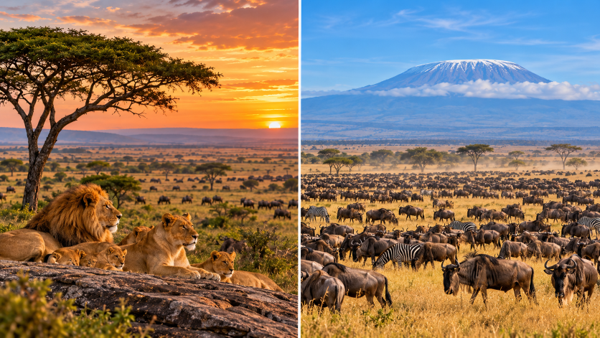
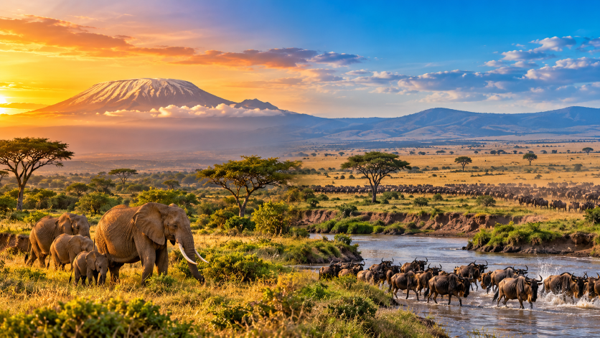
The migration is a year-round cycle, not an event that belongs to either country.
During the early part of the year, large concentrations are generally associated with the southern Serengeti and Ndutu area, including the calving season. As conditions change, herds move through different parts of the Serengeti before pushing north. During roughly July to October, large numbers can enter the greater Mara ecosystem in Kenya.
River crossings are possible in the northern Serengeti as well as the Mara because the Mara River runs through the broader ecosystem. No operator can guarantee the exact day or hour a herd will cross.
If you travel in February for calving, the Serengeti is the obvious choice. If you travel in August and want to focus on the Kenyan side of the migration, the Mara is.
Our Great Migration guide explains the annual movement in more detail.

Three nights in the Mara can do what three nights in the Serengeti may not
This is mostly a question of geography.
A three-night Mara stay can give you several early mornings and late afternoons in a compact reserve, particularly if your accommodation is positioned well. You do not need to decide which region of the park you are targeting before you arrive.
In the Serengeti, three nights work best when you deliberately choose one area. A central Serengeti stay can be excellent for general game viewing. A northern stay may make sense during the northbound migration period. A southern stay is relevant around calving season.
Trying to cover several Serengeti regions in a short stay can create the same problem we warn about on Kenya itineraries: too much movement and not enough watching.
If you have only four or five safari days in East Africa, the Mara is easier to build around. If you have a week or more in Tanzania, the Serengeti's scale becomes an advantage rather than a complication.
Access: Nairobi gives the Mara a convenience advantage
The Mara is connected to Nairobi by road and by short bush flights from Wilson Airport. Fania also arranges charter flights serving the Masai Mara.
This makes it practical to land in Nairobi and be on safari quickly, especially if you fly.
The Serengeti is usually approached through Arusha/Kilimanjaro and the northern Tanzania circuit. Many itineraries combine it with Ngorongoro Conservation Area, Tarangire National Park or Lake Manyara.
That wider circuit is one of Tanzania's strengths, but it also means the Serengeti is often best understood as one chapter in a longer journey rather than a quick weekend extension.
The Mara has conservancies; the Serengeti has scale
Another difference is how safari activities are structured around the protected areas.
Around the Mara, private and community conservancies can offer a quieter vehicle environment and, depending on the property and local rules, activities such as night drives or guided walks that are restricted in the national reserve.
The Serengeti experience is more strongly centred on the national park and adjoining protected landscapes. The sense of distance between areas can create its own form of exclusivity.
Neither model is automatically superior. A traveller who values varied activities and intimate conservancy camps may prefer Kenya. A traveller who wants days dominated by immense open landscape may prefer Tanzania.
Photography: decide whether you want concentration or scale
The Mara is particularly effective for wildlife photographers working with limited time. Predator density, open terrain and a compact area can produce repeated opportunities.
The Serengeti offers a different advantage: backgrounds and scale. A line of wildebeest can disappear into the horizon. A lion may sit in an apparently empty plain that stretches for kilometres. During the right migration phase, the volume of animals becomes the composition.
For migration photography, season and camp location matter more than the country name on the itinerary.
For big cats on a short trip, we would lean toward the Mara. For a longer migration-focused photographic safari, we would choose the correct Serengeti or Mara region for the month rather than making a permanent “best” judgement.
Crowds: both require smart planning
The Mara can become busy around famous sightings and river-crossing points during peak migration season. That is real and worth planning around.
The Serengeti's larger area often disperses vehicles more effectively, but popular locations such as central predator zones or migration crossing areas can still attract many safari vehicles.
The solution is not simply to choose Tanzania because it is larger or Kenya because conservancies exist. It is to select accommodation and guiding strategy carefully.
An experienced guide can leave a crowded sighting and find a quieter one. A camp positioned near the right habitat can reduce the amount of time spent following every other vehicle toward the same radio call.
Cost: compare complete trips, not park-fee headlines
In 2026, peak-season Mara reserve fees are high enough to influence the total price significantly. Serengeti park and concession fees, Ngorongoro costs, accommodation and Tanzania's larger transfer distances also add up quickly.
A three-night Mara safari and a six-night northern Tanzania circuit are not comparable products simply because both include big cats and wildebeest.
The honest cost comparison needs the same number of nights, similar lodge standard, similar vehicle privacy and the same season.
If budget is a major factor, read Kenya vs Tanzania for Your First Safari, then use Fania's Kenya safari cost and Tanzania safari cost guides to compare the actual structures.
Which one is better for families?
The Mara is easier to recommend for families on a short first safari because there is less pressure to cover long distances within the destination.
A private vehicle can return to camp when children have had enough, and a three-night stay can still deliver variety.
The Serengeti can be excellent for older children and teenagers who appreciate the scale and are comfortable with longer drives. Fly-in arrangements can also reduce road time substantially.
For either park, the accommodation matters. Ask about family rooms, minimum ages for certain activities, meal times and whether the lodge can provide a private vehicle.
Should you visit both?
If you have enough time, yes, but do it because you want the full ecosystem rather than because you cannot choose.
Crossing from Kenya to Tanzania is not a matter of driving straight across an invisible park boundary. You need to use recognised border and transport arrangements, which may involve road transfers, a vehicle change or a flight connection.
That means a combined trip needs more time than the map suggests.
Fania's 8 Days Splendor of Kenya & Tanzania combines Lake Naivasha, the Mara, Serengeti and Ngorongoro in a compact itinerary. For travellers who want the journey to breathe, the 15 Days Heartland of Kenya & Tanzania Wilderness gives the ecosystem much more room.

So: Masai Mara or Serengeti?
Choose the Masai Mara if:
• You have a short safari window.
• Big cats and concentrated wildlife viewing are priorities.
• You are flying through Nairobi.
• You want to pair a reserve stay with a Mara conservancy.
• You are travelling during the Kenyan phase of the migration and want the Mara to be the focus.
Choose the Serengeti if:
• You have more time.
• Scale and wilderness matter more than efficiency.
• You are travelling for the southern calving season or another Serengeti migration phase.
• You want to combine the safari with Ngorongoro, Tarangire or Zanzibar.
• You prefer a longer, slower Tanzania circuit.
Choose both if you have enough days to enjoy the border crossing as part of the itinerary rather than resent it as lost time.
Explore Fania's Kenya destinations and Tanzania destinations, or ask us to design a tailor-made Kenya and Tanzania safari around the month you are travelling.