If you can visit only one, the Masai Mara is the safer choice for most first-time safari travellers. Wildlife is more varied, big-cat viewing is usually stronger, and there is enough happening across the ecosystem to justify several days.
Amboseli becomes the better choice when elephants, photography and views of Mount Kilimanjaro matter more, or when you are building a longer Kenya itinerary and want a park that feels completely different from the Mara.
The useful question is not which park is “better”. It is which one does the job you need it to do.

The quickest way to decide
Choose the Masai Mara National Reserve if this is your first safari, you want the broadest wildlife experience, big cats are high on your list, or you are travelling during the Great Migration period.
Choose Amboseli National Park if elephants are the priority, landscape photography matters as much as species count, you have fewer days from Nairobi, or the Mara is already part of a longer itinerary and you want contrast.
If you have a week or more, the better answer may be to visit both, provided you organise the transfer sensibly.
Wildlife: the Mara is the stronger all-rounder
The Mara's advantage is not that it has one animal Amboseli does not. It is the overall density and variety of wildlife across open country.
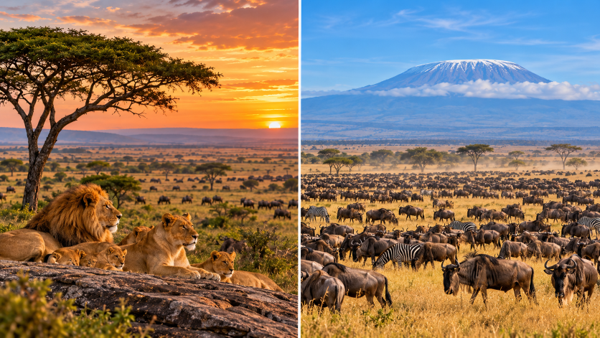
Lion and cheetah sightings are a major draw, and leopard is possible in suitable riverine and woodland habitat. Elephant, buffalo, giraffe, zebra, wildebeest, topi, gazelles and other plains game form the background to most game drives. During the northern phase of the Great Migration, the ecosystem can hold enormous concentrations of wildebeest and zebra.
There is also more room to shape the day around different habitats. One drive may focus on open grassland and predators; another may follow river systems, escarpments or quieter corners of the ecosystem.
Amboseli has strong general game viewing, including lion, cheetah, buffalo, giraffe, zebra, wildebeest and a long bird list, but elephants define the experience. Kenya Wildlife Service describes Amboseli as a premier destination for close encounters with large elephant herds, and that is an accurate way to understand the park.
If you have dreamed specifically about watching elephants walk across open plains, Amboseli deserves its place even if the Mara is technically the more complete wildlife destination.
Elephants: this is where Amboseli takes over
It is difficult to separate Amboseli from elephants.
The park's wetlands and wider ecosystem support herds that can be watched at close range as they move between feeding grounds and water. You often have time to observe family behaviour rather than simply ticking off a sighting.
That changes the pace of a game drive. A herd may take twenty minutes to cross an open area. Calves disappear between adults. Older animals stop to feed. The scene develops slowly, which is exactly what wildlife photography often needs.
The Mara also has elephants, sometimes in large groups. But if elephant behaviour is one of the main reasons you are coming to Kenya, Amboseli is the more focused choice.

Big cats: give the Mara more time
For a traveller whose safari wish list begins with lion, cheetah and leopard, we would put more nights into the Mara.
Its open grasslands are excellent hunting country, and the broader Mara ecosystem has a long reputation for predator viewing. That does not mean every drive produces drama. Cats spend a large part of the day resting, and leopard remains elusive by nature. But the odds and the range of predator habitat are strong enough that the Mara is usually the better first choice.
Amboseli has predators too. Lion and cheetah are seen, and the park's openness can create excellent sightings. The difference is emphasis rather than absence.
If your ideal safari morning involves spending two hours following a pride or waiting for a cheetah to move, the Mara generally offers more opportunities to build days around that kind of viewing.
Scenery: Amboseli can win before the animals appear
The Mara looks like the Africa many travellers have imagined: rolling grassland, scattered acacias, riverine woodland and enormous skies.
Amboseli is more graphic.
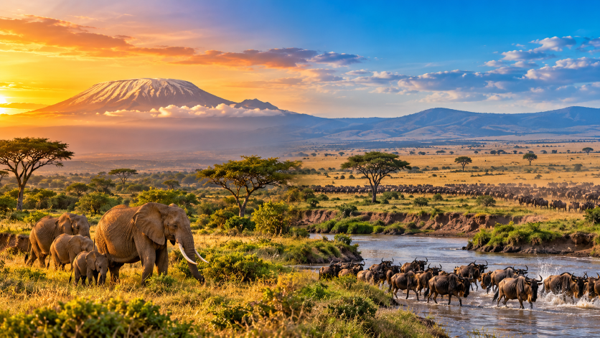
Dusty plains, bright wetlands, palm and acacia, animals crossing shallow water and Kilimanjaro rising beyond the Kenyan border create a landscape with unusually strong visual identity. The mountain is not visible all the time; cloud can build quickly, which is why early mornings matter.
When Kilimanjaro is clear, Amboseli can produce photographs that need very little explanation.
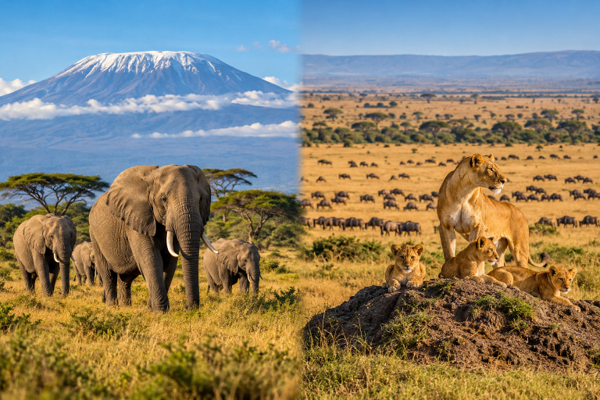
For landscape-led photography, elephants and a sense of place, Amboseli has the advantage. For wildlife variety and action across a broader ecosystem, the Mara does.
The Great Migration changes the comparison
From roughly July into October, the migration commonly moves into the greater Mara ecosystem, although herd movement and river crossings depend on rainfall and cannot be scheduled precisely.
If your trip is specifically about witnessing migration concentrations or the possibility of Mara River crossings, the Masai Mara is the relevant Kenyan destination. Our Great Migration guide explains how the cycle continues through the Serengeti for the rest of the year.
Amboseli does not compete with that event. Its strength is year-round resident wildlife and its elephant-led ecosystem.
That is why comparing the two parks during migration season can be misleading. One is temporarily hosting part of the world's largest terrestrial wildlife movement. The other is doing what it does well throughout the year.
Which park is easier from Nairobi?
Amboseli is the simpler road trip. Kenya Wildlife Service lists road access from Nairobi at roughly 200 to 220 kilometres depending on the gate and route. In ordinary safari planning terms, that makes it practical for a shorter trip from Nairobi, although traffic and road conditions always affect actual transfer time.
The Mara takes longer by road. The drive is part of many classic Kenya safaris, but if you only have a few days and do not want to lose a large portion of them in transit, flying becomes attractive.
Fania can arrange charter flights to the Masai Mara and charter flights serving Amboseli. Scheduled bush flights can also be appropriate depending on your dates and route.
For a longer safari, the decision should be based on the whole circuit rather than which park sits closest to Nairobi.
Cost: the Mara can become significantly more expensive
Accommodation level matters in both parks, but park fees can shift the balance.
As of September 2026, Kenya Wildlife Service lists non-resident adult entry to Amboseli at US$90 per day. Published 2026 Mara fee guidance lists non-resident adult reserve entry at US$100 per day from January through June and US$200 per day from July onward, with separate child and resident rates.
That difference becomes meaningful over three or four nights, especially during migration season when accommodation is also at its most expensive.
It does not automatically make Amboseli the cheaper holiday. Your lodge, vehicle, guide, transfers, flights and number of travellers all matter. But if two itineraries look similar and the Mara version is substantially more expensive in peak season, reserve fees are part of the explanation.
For a broader breakdown, see our Kenya safari cost guide and our article on what a seven-day Kenya safari really costs.
Families: the decision is more about pace than animals
Both parks can work very well for families.
Amboseli's more compact scale can suit younger children because the journey from Nairobi is simpler and excellent wildlife can be found without planning an enormous circuit. Watching elephants is also an easy experience for children to understand; you do not need to wait for a rare animal to make the drive feel successful.
The Mara offers greater variety, which can be useful for older children and teenagers. It also has a much wider accommodation range across the reserve, surrounding conservancies and nearby areas.
For families, we would pay close attention to drive duration, swimming pools, meal flexibility, family rooms and whether the lodge welcomes the age group travelling with you. The right property can matter as much as the park.
Photographers: choose the subject before the park
Ask what you want to photograph.
For big cats, action and varied wildlife, choose the Mara. For elephants, layered landscapes, dust, wetlands and Kilimanjaro compositions, choose Amboseli.
Fania's 8 Days Kenya Spectacular Photography Safari combines Amboseli, Lake Naivasha and the Mara precisely because the three locations produce such different visual material.
Photographers should also think about vehicle occupancy. A private vehicle can be more valuable than upgrading the lodge if it means you control positioning, departure time and how long you stay with a subject.
Can you visit both in one trip?
Yes, but do not pretend they are next door to each other.
A direct road transfer between the two is long. On a seven-day trip, we prefer to make the route earn its kilometres. One approach is to place a Rift Valley stop such as Lake Naivasha between major safari areas, creating a change of pace rather than using every day as a transfer.
Another is to use a flight for the least interesting or most time-consuming leg.
A first-visit structure such as Amboseli (2 nights) – Naivasha (1 night) – Masai Mara (3 nights) works because each stop contributes something different. We explain that route in our recommended seven-day Kenya safari.

So which would we choose?
If this is your first African safari, you have enough time for only one major wildlife destination and your interests are broad, choose the Masai Mara.
If elephants are the priority, you care deeply about landscape photography, or you are adding a second park to a longer Kenya trip, choose Amboseli.
If you have seven days or more, the answer may be to stop treating them as competitors. They complement each other unusually well: the Mara gives you wildlife density and predators; Amboseli gives you elephants and one of Kenya's most recognisable landscapes.
Explore Fania's Kenya destinations, browse our African safari itineraries, or ask us to build a tailor-made Kenya safari around the number of days you actually have.