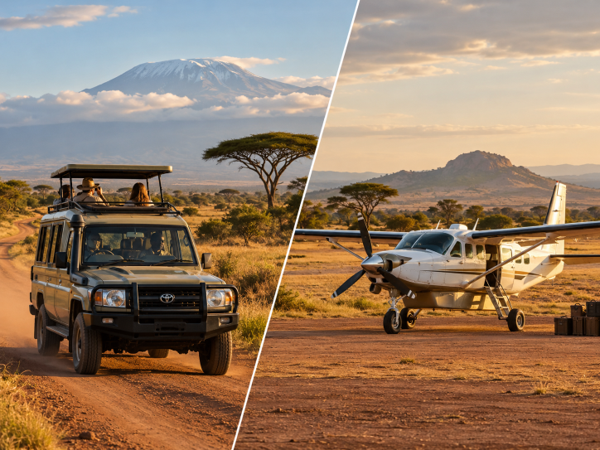
A fly-in safari is not automatically better because it is faster. A road safari is not automatically more “authentic” because you see more countryside.
The right choice depends on what the transfer is doing for the trip.
If a road journey connects two places naturally and lets you understand how Kenya changes between ecosystems, it can be part of the experience. If it consumes most of a short holiday and leaves you exhausted before the evening game drive, flying may be money well spent.
For many first-time travellers, the best answer is a hybrid safari: drive the legs that make geographical sense and fly the ones that do not.

What a road safari gives you
A road safari starts building context before you reach the gate.
Leaving Nairobi for Amboseli National Park, you watch the city give way to open country and the southern landscape. Travelling into the Rift Valley, the escarpment changes the scale of the journey. On other routes, you pass farms, towns and grazing areas that never appear in safari photography.
That matters if you want to experience Kenya as more than a sequence of wildlife reserves.
Road travel also keeps the same guide and vehicle with you for much of the trip. Your luggage stays in one place, there are no airport check-ins between parks, and the 4x4 that transfers you can often be the same one used for game drives.
For families or travellers carrying a lot of photography equipment, that simplicity has real value.
What a fly-in safari buys you
Flying buys time and energy.
The Masai Mara is the obvious example. By road, the journey from Nairobi occupies a substantial part of the day. By air from Wilson Airport, the flight itself is short, allowing you to leave Nairobi in the morning and potentially be on a game drive not long after reaching camp.
That difference becomes more important when your whole safari is only three or four nights.
Fly-in safaris can also make remote or widely separated areas realistic within one itinerary. Instead of treating an entire day as transport, you can turn part of it into wildlife time.
Fania arranges charter services, including flights serving the Masai Mara and Amboseli.

The time saving matters most on short trips
If you have two weeks, a five-hour road journey can be a reasonable part of the holiday.
If you have four safari days, the same transfer is a major percentage of your trip.
This is why we look at wildlife hours gained, not simply the price difference between road and air.
A fly-in option becomes compelling when it changes the day from:
breakfast → six hours on the road → late lunch → short evening drive
into:
breakfast → short flight → camp transfer → lunch → proper afternoon drive
The aircraft has not made the wildlife better. It has changed how much of the day you have available to see it.
Road routes work best when the sequence is logical
Road travel is strongest when destinations fall into a sensible circuit.
Our recommended first-time structure of Amboseli → Lake Naivasha → Masai Mara works because Lake Naivasha breaks the east-to-west movement and gives the trip a different experience in the middle.
The 7 Days Classic Nairobi, Naivasha & Maasai Mara Itinerary is another route where road travel is part of the logic rather than dead time.
A badly designed road safari is different. If the itinerary repeatedly doubles back through Nairobi or asks you to cross huge distances just to add one extra park, the savings can become false economy.
You may spend less money but lose the thing you travelled for: time in the bush.
Fly-in safaris work best when geography is fighting you
Air travel makes more sense when destinations are distant, when you are connecting safari and beach, or when physical comfort matters.
A traveller finishing several days in the Mara may prefer to fly onward rather than spend another long road day. A honeymoon couple with only eight nights in Kenya may value an extra afternoon at camp more than the money saved on the road. Older travellers or families with very young children may simply find repeated full-day drives tiring.
Flights are also useful when the route includes conservancies or camps with convenient airstrips that would otherwise require a long detour.
The trick is not to fly every leg by default. Some short flights require transfers to and from airstrips, check-in time and schedule coordination. On certain routes, a well-planned road transfer can be nearly as efficient once the full door-to-door journey is considered.
Luggage is the hidden fly-in issue
Photographers need to think beyond the ticket price
For photographers, flying solves one problem and creates another.
The time saving is valuable. More mornings and evenings in good light can justify a flight quickly.
But camera bodies, long lenses, laptop equipment and batteries are heavy. A 15 kg total allowance can be restrictive when photographic gear alone approaches that figure.
Options may include buying excess baggage in advance, arranging a freight seat, storing unnecessary luggage in Nairobi or moving some equipment by road, depending on the airline and route.
This is the kind of detail to solve at booking stage, not at Wilson Airport twenty minutes before departure.
Once in the reserve, a private safari vehicle may be more important to the photographer than whether the transfer was flown. Fania's 8 Days Kenya Spectacular Photography Safari can be adapted around those priorities.
Families: flying can remove the hardest part of the day
Young children do not necessarily appreciate a six-hour transfer, even if the view is interesting to adults.
Flying can make a family itinerary much easier, particularly when the safari is short. The excitement of a small aircraft and bush airstrip can even become part of the trip.
But flights also come with fixed departure times, baggage rules and airport procedures. Families carrying car seats, pushchairs or additional supplies need to check exactly what the airline accepts.
For some families, a private road vehicle is actually simpler because everything stays in the vehicle and the guide can stop when necessary.
There is no universal family answer. The age of the children matters more than the marketing category of the safari.
What about comfort?
Long road transfers can be tiring, especially on rougher approaches to reserves.
Small aircraft are faster, but they are not the same as flying business class between cities. Cabins can be compact, turbulence is possible and passengers may make several stops as the aircraft picks up or drops off guests at different airstrips.
Travellers who dislike small aircraft may prefer the road even if it takes longer.
Travellers who struggle with long periods sitting in a vehicle may prefer the flight.
Choose the form of discomfort you personally tolerate better rather than assuming one is universally luxurious.

Cost: compare the whole itinerary
Road safaris are generally cheaper because a private 4x4 and guide can serve the trip continuously, especially when several people share the vehicle.
Flights add ticket costs, and you still need a game-drive vehicle at the destination. A fly-in camp package may include shared game drives, while a private vehicle can cost extra.
That means a cheap-looking airfare does not necessarily show the full difference.
On the other hand, flying may allow you to remove a hotel night or avoid a long transfer day. If you are paying several hundred dollars per night for safari accommodation, buying back half a day in the park can be good value.
Our Kenya safari cost guide and 7-day safari cost breakdown explain the other parts of the budget.
The hybrid safari is often the smartest version
A hybrid trip uses each transport mode where it is strongest.
You might drive from Nairobi to Amboseli because the road connection is straightforward, continue through the Rift Valley, then fly from the Mara back to Nairobi at the end to protect your final day.
Or you might drive the main safari circuit and fly from the bush to the coast, avoiding a long cross-country transfer before a beach stay.
This is often the most sensible balance between price and time.
Fania's 9 Days Treasures of the Wilderness and Beach is the kind of itinerary where transport choice can be tailored to how much of the journey you want to do on the ground.
A simple decision guide
|
Road safari suits you if... |
Fly-in safari suits you if... |
|
You have enough days |
Your safari is short |
|
Budget matters more than speed |
Time matters more than cost |
|
You enjoy seeing the country between parks |
Long road transfers tire you |
|
You carry more luggage or camera gear |
You can travel light |
|
Your parks form a logical road circuit |
Your destinations are far apart |
|
You want one guide and vehicle throughout |
You are comfortable changing vehicles/camps |
If you are still building your route, read Planning Your First Safari in Kenya and How Many Days Do You Need for a Kenya Safari?.
Then send Fania your dates, party size and luggage needs. We can compare road, scheduled air and charter options against the actual route rather than deciding that one transport style is always better.