
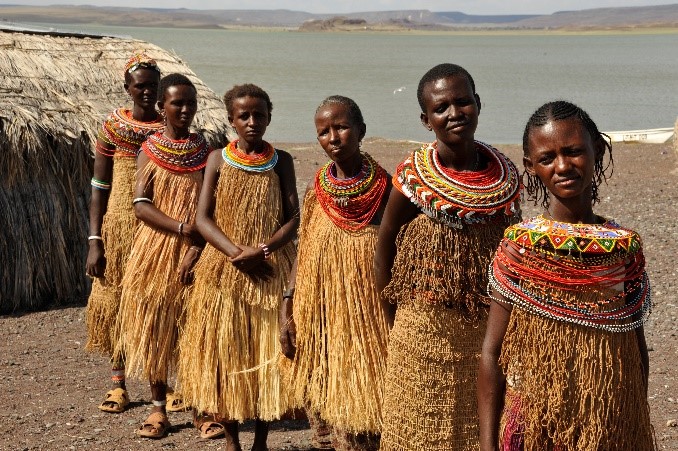
A closer look at Elmolo.
Understanding El Molo heritage on Lake Turkana
The El Molo are a small community closely associated with the southeastern shores and islands of Lake Turkana in northern Kenya. Their history is linked to the lake, fishing knowledge and adaptation to a demanding environment. Accounts of El Molo identity and language should be approached carefully because language shift and intermarriage have shaped community life.
History and cultural context
Fishing and use of lake resources feature prominently in descriptions of El Molo history. The community has maintained social connections with neighbouring peoples, and researchers document substantial linguistic change over generations. It is misleading to present El Molo society as isolated, unchanged or defined solely by population estimates that vary across sources.
Cultural life today
Lake Turkana is both a lived environment and a landscape subject to ecological and economic pressures. Modern education, access to services, fishing livelihoods and local cultural preservation efforts all form part of the story. A responsible guide should recognise that regional environmental change and access to water resources matter as much as visible cultural artefacts.
Fishing knowledge and language
Lake ecology has informed generations of fishing practice, boat use, food preparation and seasonal decisions. El Molo history is also a story of exchange with neighbouring pastoral societies. Linguistic research by Mauro Tosco documents remembered elements of the earlier Cushitic El Molo language and community efforts to reclaim linguistic heritage after substantial language shift. Language histories should not be confused with the disappearance of a people.
Lake Turkana as a living landscape
The lake's variable conditions and the distance between settlements shape access to education, health services and markets. Cultural descriptions are strongest when they connect fishing heritage with contemporary local livelihoods and environmental stewardship. Visitors should not arrive expecting a scheduled performance or assume that households are open to casual photography. Community arrangements and road conditions need to be checked ahead of travel.
Visiting respectfully
Any visit should be arranged with locally accountable hosts and careful logistical planning. Seek permission before taking photographs or asking about family histories. Avoid describing a community as “disappearing”; use precise, sourced discussion of language endangerment and living cultural continuity.
Planning a respectful cultural experience
Travellers should choose experiences designed or authorised by the people involved, agree terms and photography permissions in advance, and understand that community life does not exist for visitor entertainment. The most valuable exchange is a conversation in which hosts decide what to explain. Travel arrangements, visitor access and any advertised activities must be confirmed locally before booking; this guide does not guarantee a particular cultural visit.
